
Digital sovereignty of local authorities: three concrete budgetary levers for public CIOs in 2026
Digital sovereignty of local authorities: three concrete budgetary levers for public CIOs in 2026
The Coter Numérique congress will be held in Reims on June 23-24, 2026, on a theme that is anything but trivial: "Local authorities facing the challenges of digital sovereignty". The 2025 edition brought together 1,300 public IT decision-makers around more than 120 workshops. The 2026 edition is set in a tougher context. The NIS2 directive enters its implementation phase, public IT budgets are tightening, dependence on extra-European solutions is worsening, and each local authority CIO must deal with an equation that no one has funded. This article proposes three concrete levers to solve it, including one that is underutilized in public debate.
The new equation for local authority CIOs
For local authority CIOs, the 2020s resemble a piling up of simultaneous constraints. Modernizing digital public services requires new tools. The cloud transformation by major software companies reformats recurring costs. The cyber pressure, accelerated by attacks on hospitals and French local authorities since 2020, requires investment in defense solutions. And the NIS2 directive, transposed and now effective, introduces security and governance obligations that did not exist for most territorial entities.
All this happens on a constant or decreasing budget. Funds dedicated to the state's digital transition, such as France Relance or France 2030, have funded targeted programs but do not cover the foundation. The IT operating budget of a metropolis, department, or intercommunality remains largely the same as five years ago, while the cost of each component has increased.
The Coter Numérique 2026 congress does not thematize sovereignty by chance. Sovereignty is what public CIOs are asked for when no one has figured out how to finance modernization. Without new means, the trajectory is untenable. The three levers that follow aim precisely at this gap.
Lever 1: Rebuild the software asset mapping before any other arbitration
The first mistake that many public CIOs continue to make is reasoning by addition. Cybersecurity is added to the existing budget. NIS2 compliance is added to the existing budget. Sovereign cloud is added to the existing budget. With each addition, it is discovered that a line is missing.
Exiting this logic involves a rigorous mapping of existing software assets. For most local authorities, the actual inventory of licenses in place, the effective usage rate, and the underlying contracts are patchy. Business services have accumulated tools, some paid at headquarters, others billed to the service, and still others renewed by tacit agreement without usage review. A significant portion of the inventory is underutilized or redundant.
This mapping is not a classic IT audit project. It is a financial discipline serving budgetary management. Once established, it reveals three categories of assets: licenses oversized compared to actual usage, perpetual licenses no longer used that are dormant in the inventory, and contracts that should never have been renewed as they were.
This first step already produces, in most cases, between 5 and 15% of recurring savings. These savings fund the next steps.
Lever 2: Integrate the secondary software license market into public procurement
This is the least discussed lever in the territorial digital ecosystem, and probably the most profitable in the short term. The secondary software market allows a local authority to resell perpetual licenses it no longer uses and to buy second-hand licenses it would otherwise have purchased at the new price.
The legal framework is clear. The Court of Justice of the European Union established in 2012, in the UsedSoft ruling, that the resale of perpetual software licenses is legal within the European Economic Area, provided the original seller effectively uninstalls the software and transfers the entire license. French and German case law has since consolidated this principle and clarified the operational conditions. A local authority can therefore sell and buy on this market without legal risk, provided it goes through an intermediary who secures the ownership chain.
The savings are significant. Discounts observed on the secondary market range from 20 to 70% compared to the new price, depending on the publisher, version, and volume. For an authority equipping 5,000 workstations with an office suite or operating system, the gap over three years often exceeds several hundred thousand euros.
Integration into public procurement requires some precautions. The market must be drafted to explicitly authorize the provision of licenses on the secondary market, which is not the default wording. Contractual traceability, proof of uninstallation at the previous holder, and formal transfer of the license must be included in the specifications. Several French authorities have already passed tenders explicitly integrating the secondary market: the mechanics are proven.
The benefit is not limited to savings. The resale of dormant licenses allows the authority to recover cash that does not appear in any classic budget line. This cash can finance part of the sovereignty trajectory or NIS2 compliance without requesting additional funds from the supervising authority.
Lever 3: Rethink the renewal schedule and negotiation strategy
The third lever is more strategic than technical. Most local authority CIOs negotiate their software contracts when the publisher forces them to, that is, at the renewal date. This posture, natural, is exactly what produces the worst budgetary results.
Three changes transform the negotiation posture.
The first involves knowing the resale value of the current inventory on the secondary market. This information, obtainable in a few days via a specialized marketplace, gives the authority a real alternative to renewal. Without this alternative, the negotiation is unilateral. With it, the publisher knows that part of the inventory can be sold rather than migrated.
The second involves anticipating the negotiation 12 to 18 months in advance, not three months before the deadline. This anticipation allows for the evaluation of migration options, purchasing second-hand the volumes needed to maintain critical use during the transition, and presenting the publisher with a credible trajectory rather than a discount request.
The third involves aligning IT negotiation with the purchasing and financial departments. Too many public CIOs negotiate alone, when the publisher imposes the conversation. When the CIO, purchasing, and finance departments come together with an asset mapping, a documented trajectory, and a secondary option, the balance of power changes radically. Publishers in a dominant position remain dominant, but they consent to substantial adjustments they refuse in front of an isolated interlocutor.
Sovereignty as a budgetary discipline, not as a discourse
The risk, when talking about digital sovereignty for local authorities, is to produce a discourse that substitutes for action. Sovereignty is not decreed in a resolution or a statement. It is funded, brick by brick, in the arbitration between what is kept, what is sold, what is repurchased, what is migrated.
The three levers described here, asset mapping, secondary market, negotiation recalibration, do not cover the entire field. They do not replace the migration to sovereign solutions when necessary. But they finance this migration without asking for additional budget, and they give local authority CIOs the leeway they need to execute.
The Coter Numérique 2026 congress will be an opportunity to discuss these levers in practice, with colleagues who have already passed the stage, and with market players who can operate them. Real discussions often take place on the sidelines of plenaries.
Conclusion: what is really shifting in territorial digital
The 2026 edition of Coter Numérique marks a shift in positioning. The public CIO moves from a role of digital transformation operator to a role of financial strategist of sovereignty. This shift is not comfortable. It requires talking numbers with elected officials who speak politics, talking publishers with lawyers who speak public procurement, talking secondary market with colleagues who have never heard of it in their initial training.
But this shift is what makes the trajectory tenable. A financed digital sovereignty is a sovereignty that holds. A sovereignty decreed without funding remains a slogan that operational constraints will exhaust in two years.
We will be present at Coter Numérique 2026 in Reims to discuss concrete arbitrations and feedback from local authorities that have already integrated the secondary market into their IT trajectory.
Sources
Coter Numérique, 2026 congress program, Reims, June 23-24, 2026.
Court of Justice of the European Union, UsedSoft GmbH v. Oracle International Corp., Case C-128/11, July 3, 2012.
Cigref, The secondary software market, positioning document.
Directive (EU) 2022/2555 (NIS2), transposed into French law.
Cigref and Institut Montaigne, data on European digital dependence.
Autres Events
See all
The Secondary Software Market: The Digital Sovereignty Lever France Underutilizes
Reducing dependency on GAFAM is not only about sovereign cloud. The secondary software license market is a legal, structured, and underexploited tool for digital sovereignty. Analysis on the occasion of the Digital Sovereignty Salon 2026 in Paris.
See more
Software Asset Management in 2026: Why the Secondary License Market Now Belongs in Your SAM Strategy
Cloud licensing inflation, post-Broadcom turbulence, AI workloads, and the UsedSoft ruling: why the secondary software market is now a structural pillar of SAM strategy. Analysis ahead of SAMS Nordic 2026 in Copenhagen.
See more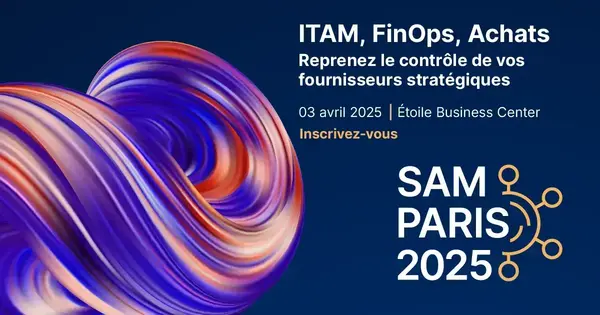
Softcorner at SAM Paris 2025: Reduce Your Software Costs and Secure Your Compliance
On April 3, 2025, Softcorner will be a Gold Sponsor at SAM Paris 2025, the must-attend event dedicated to Software Asset Management (SAM). Come and discover how to optimize your software investments, reduce your costs, and ensure your compliance with IT audits. Our team will welcome you at our booth and host an exclusive workshop to help you regain control of your IT budget.
See more