Software Asset Management in 2026: Why the Secondary License Market Now Belongs in Your SAM Strategy
Software Asset Management in 2026: Why the Secondary License Market Now Belongs in Your SAM Strategy
The 2026 edition of SAMS Nordic opens in Copenhagen on June 15 and 16, in a licensing market that has rarely been this turbulent. Broadcom's takeover of VMware reshaped the cost base of an entire industry. AI workloads exposed the limits of legacy ELPs. Subscription models, sold as flexibility, locked procurement teams into multi-year minimums. In that context, software asset management strategy is being quietly rewritten across European IT estates. One of the levers driving that shift is the secondary software market.
The 2026 SAM landscape, in one sentence
For a decade, software asset management was largely a compliance discipline. The KPI was avoiding audit findings. The tooling was a discovery agent and a reconciliation spreadsheet. Procurement and SAM rarely shared a calendar.
That model is now obsolete. Three structural shifts pulled SAM into the strategic perimeter of the CIO and the CFO.
The first is the post-Broadcom recalibration. VMware customers facing renewal in 2025 reported cost increases of two to ten times depending on bundle and core count. The shock spread beyond VMware: every publisher with a similar customer base now tests how far it can push subscription minimums and per-core escalators.
The second is the maturation of the legal framework around used software licenses. The 2012 UsedSoft ruling by the Court of Justice of the European Union established that publishers cannot oppose the resale of perpetual software licenses inside the EU once the rights have been exhausted by a first sale. More than a decade of downstream jurisprudence consolidated the principle and clarified what is enforceable.
The third is the rise of AI and container workloads, which broke the assumptions baked into legacy enterprise license programs. SAM teams now have to defend compliance positions on metrics that did not exist when the contracts were signed.
If you are heading to SAMS Nordic 2026, you will hear those three forces named, sometimes separately, sometimes together. The argument of this article is that they have to be read together, because together they make the secondary software market a structural component of any serious SAM strategy.
What the post-Broadcom market actually changed
The Broadcom acquisition of VMware closed in late 2023. Within two quarters, the new owner had simplified the product portfolio, retired perpetual licensing on most SKUs, and pushed customers into VMware Cloud Foundation subscription bundles with elevated core minimums. By mid-2025, public reports from large European customers, including Telefónica Germany and several public sector agencies, documented renewal increases that ranged from 250 percent to over 1000 percent.
The strategic implication for SAM is not that VMware became expensive. It is that perpetual licensing, written off by some analysts as a legacy artifact, suddenly became the most valuable asset on the balance sheet of every CIO who still held it.
Two consequences follow. First, organizations that had perpetual VMware licenses in inventory but stopped using them have a real, transferable asset. Second, organizations that need to delay a forced migration to a new model can buy that runway from a secondary marketplace instead of accepting the publisher's renewal terms. Both flows feed the same market.
This dynamic is not specific to VMware. Microsoft, Oracle, SAP, IBM, and Adobe portfolios all contain perpetual SKUs whose value on the secondary market is now correlated with the cost of moving to the publisher's cloud or subscription equivalent. SAM teams that understand this correlation can model their own optimization more accurately than teams that only look at compliance.
The legal foundation, briefly
Most SAM professionals encounter the question of legality early in any conversation about the secondary software market. The short answer: in the European Union and the European Economic Area, the resale of perpetual software licenses is legal and enforceable, subject to specific conditions established by case law.
The reference decision is UsedSoft v. Oracle, ruled by the Court of Justice of the European Union on July 3, 2012. The court applied the doctrine of exhaustion to software, holding that once a publisher sells a perpetual license, the rights of distribution are exhausted and the customer can resell. Subsequent decisions, including national rulings in Germany, France, and the Netherlands, refined the operational conditions: the original buyer must remove the software from its systems, the license must be transferred in full, and a clear chain of title must be auditable.
For a SAM strategy, the operational consequence is simple. A licensed asset that is documented, deactivated on the seller side, and transferred via a marketplace with proper provenance handling is a legitimate SAM input. It can be acquired with the same audit posture as a direct purchase from the publisher, and resold with the same level of contractual safety.
That legal clarity is the precondition for the rest of the argument. Without it, the secondary software market would be a niche workaround. With it, the market becomes a normal sourcing channel.
Where the savings really are
A useful frame for SAM teams is to read the secondary market not as a discount channel, but as a margin recovery mechanism. The discount is real, typically between 20 and 70 percent off list price depending on publisher, version, and volume, and reaching higher levels on portfolios that the publisher has discontinued or repositioned. But the more strategic value sits elsewhere.
The first margin lever is shelfware monetization. Most large estates carry between 15 and 30 percent of unused licenses, accumulated through workforce shifts, project cancellations, and cloud migrations. Those licenses are an unrealized asset on the balance sheet. A secondary market provides a route to convert them into capital that can fund the next migration, the next security tool, or the next architectural change.
The second margin lever is migration runway. Most publishers now use renewal moments to enforce model changes that increase total cost. A SAM team that can extend the life of its current perpetual estate by 12 or 18 months through targeted secondary acquisitions buys time to negotiate the next contract from a position of strength rather than from a position of forced compliance.
The third margin lever is decoupling from the publisher's roadmap. When a SAM team only buys from the publisher, every renewal is a unilateral conversation. When the team has a credible alternative path, the conversation becomes bilateral. The mere existence of the secondary market changes the negotiation, even when no transaction takes place.
What the SAMS Nordic 2026 agenda confirms
The agenda of SAMS Nordic 2026 reads like a map of these shifts. Tracks on Mastering Cloud Services, New Cloud Licensing Models, Advancing Vendor Management, Rethinking Audit Policies and Software Portfolio Centralization all point to the same underlying problem: SAM is being asked to optimize an environment in which the rules are being rewritten faster than the tools can adapt.
The implicit conclusion of that agenda is that SAM cannot be only a defensive function. It has to be an active component of cost strategy. That requires three changes in operating model.
The first change is calendar. SAM activity has to align with procurement and finance cycles, not with the publisher's audit cycle. Inventory of resellable assets has to be a quarterly exercise, not a triennial one.
The second change is sourcing. The secondary market has to be onboarded as a recognized supplier route, with the same procurement discipline as a direct contract. This includes legal review of the marketplace's process, audit of the chain of title, and integration into the SAM tool.
The third change is decision rights. The decision to renew, migrate, or repurchase from the secondary market has to sit at the same table as the decision to sign a new ELP. Splitting those decisions across silos is what produces the worst total cost outcomes.
Practical signals SAM teams should monitor in 2026
Five signals deserve continuous monitoring inside any SAM function this year.
Signal one: the publisher's pricing curve on subscription minimums. Every escalator clause that crosses a threshold of 15 percent year on year is a candidate for arbitrage against the perpetual market.
Signal two: the publisher's discontinuation announcements. End of support for a perpetual SKU often increases its secondary value rather than decreasing it, because customers running stable workloads delay migration.
Signal three: internal shelfware ratios. Any business unit running below 75 percent active utilization on a perpetual entitlement is a candidate for partial resale.
Signal four: contract clauses on transferability. Some recent enterprise agreements introduce restrictions that conflict with the UsedSoft framework. SAM teams that catch this in negotiation save themselves a decade of constraint.
Signal five: secondary market price benchmarks. Treating the secondary market as a pricing reference, even when not transacting, provides a baseline that the publisher cannot ignore in a renewal conversation.
Closing: SAM as a financial discipline
By 2026, the dividing line in IT asset management is no longer between mature and immature SAM functions. It is between SAM functions that operate as compliance gatekeepers and SAM functions that operate as financial disciplines. The first will continue to optimize within the box drawn by the publisher. The second will use every legitimate lever, including the secondary software market, to reshape the box itself.
We will be at SAMS Nordic 2026 in Copenhagen on June 15 and 16 to discuss what we observe across thousands of transactions on our marketplace, including the patterns that are most useful for SAM strategy. Catch up at the venue, bring your hardest licensing case.
Habibou M'BAYE, Softcorner. April 2026.
Sources
we.CONECT Global Leaders, SAMS Nordic 2026 program, Copenhagen, June 15-16.
Cigref, Le marché secondaire du logiciel, position paper.
Public reporting on Broadcom-VMware licensing changes, 2024-2025.
Autres Events
See all
The Secondary Software Market: The Digital Sovereignty Lever France Underutilizes
Reducing dependency on GAFAM is not only about sovereign cloud. The secondary software license market is a legal, structured, and underexploited tool for digital sovereignty. Analysis on the occasion of the Digital Sovereignty Salon 2026 in Paris.
See more
Digital sovereignty of local authorities: three concrete budgetary levers for public CIOs in 2026
NIS2, dependence on GAFAM, constrained IT budgets: how can the CIOs of local authorities finance their digital sovereignty trajectory without budget extensions in 2026. Analysis on the occasion of the Coter Numérique.
See more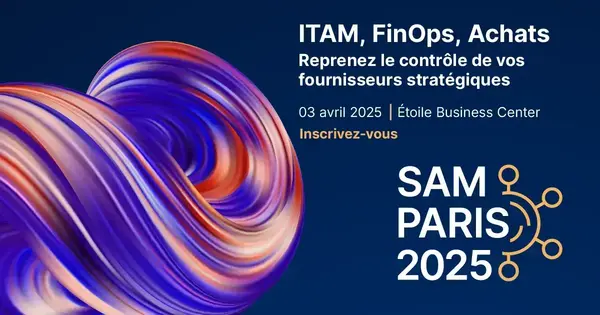
Softcorner at SAM Paris 2025: Reduce Your Software Costs and Secure Your Compliance
On April 3, 2025, Softcorner will be a Gold Sponsor at SAM Paris 2025, the must-attend event dedicated to Software Asset Management (SAM). Come and discover how to optimize your software investments, reduce your costs, and ensure your compliance with IT audits. Our team will welcome you at our booth and host an exclusive workshop to help you regain control of your IT budget.
See more